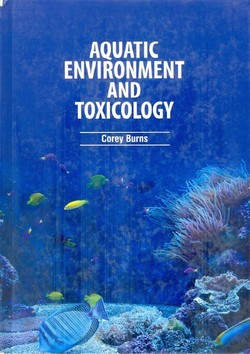
Aquatic Environment and Toxicology
By
Corey Burns
Preface
Recently, awareness of the adverse effects of chemical contaminations is growing as investigations into these pollutants increase and analytical detection techniques improve. The aquatic environment, as an important component of the biosphere, has been termed "the ultimate sink" for natural and man-made chemicals. Given the finite supply of water available, the continued chemical contamination of the aquatic environment may pose a significant environmental health hazard.
Ecology is the scientific study of how organisms interact with each other and with their environment. This includes relationships between individuals of the same species, between different species, and between organisms and their physical and chemical environments. Aquatic ecology includes the study of these relationships in all aquatic environments, including oceans, estuaries, lakes, ponds, wetlands, rivers, and streams.
An ecosystem is a community of living organisms and their physical and chemical environment, linked by flows of energy and nutrients. Ecosystems function as a discrete ecological unit, and can be defined at a variety of scales. For example, the Athabasca River basin can be considered an ecosystem, as can a small pond, a log, or the entire planet. The boundaries of an aquatic ecosystem are somewhat arbitrary, but generally enclose a system in which inflows and outflows can be estimated. Ecosystem ecologists study how nutrients, energy, and water flow through an ecosystem.
Pollution of Aquatic systems (Examples: lakes, rivers, oceans, aquifers and groundwater) by large amounts of waste material that modify the water in negative fashion is termed as Aquatic Pollution. This type of ecological deprivation occurs when harmful pollutants are directly or indirectly discharged into aquatic systems without removal of harmful compounds. Aquatic pollution directly leads to suffering of organisms and vegetation that survive in water, including amphibians.
Toxicology is the scientific study of adverse effects that occur in living organisms due to chemicals. It involves observing and reporting symptoms, mechanisms, detection and treatments of toxic substances, in particular relation to the poisoning of humans. Toxicology is an interdiscipline that requires the knowledge of many areas such as analytical chemistry both organic and inorganic, biochemistry, pathology and physiology. Toxicology is the science of poisons (also called toxins). It deals with the chemical nature of poisonous substances and how they produce adverse effects in biological systems. A poison is generally defined as any chemical agent that has the capacity to produce abnormal, undesirable, or harmful changes to an organism exposed to it. Poisoning by a chemical agent is equivalent to chemically induced disease. In humans, adverse effects of poisons can range from minor symptoms like headache and nausea to severe ones like convulsions and coma. The ultimate adverse effect is death. The toxicity of a chemical is an inherent property of the chemical. It cannot be changed without changing the chemical to another form. Most toxins work by altering basic cellular metabolic functions in ways that disrupt normal physiological processes. They are also the target of biochemical reactions in the body that render them inactive (detoxification). Toxicology is a complex, interdisciplinary subject, straddling the fields of chemistry, biology, pharmacology, medicine, genetics, economics, and law.
Toxicology is the study of the adverse effects of chemicals on living systems, whether they be human, animal, plant or microbe. 'Adverse effect' can range from a life threatening injury to something that might be considered a minor annoyance. A mild irritant that causes watering of the eyes may not seem like a significant or real adverse effect, but for the person operating fine equipment, such effect can be not only deleterious but potentially dangerous.
The present book mainly deals with aquatic environmental, aquatic pollution, environmental toxicology and updates the subject matter, illustrations and problems to incorporate new concepts and issues related to aquatic ecosystem and environmental toxicology. The approach to presenting this book is traditional covering of environmental pollution, aquatic ecosystem and environmental toxicology.
Contents
Chapter 1: Concepts in Aquatic Environment
Chapter 2: Aquatic Pollution and its Management
Chapter 3: Water and Environmental Pollution Control and Prevention
Chapter 4: Toxicology
Chapter 5: Environmental Toxicity
Chapter 6: Aquatic Toxicology and Water Pollution
***for more please visit the library***
Prep. / Ayman Ashry
Manage. / Mona Mahmoud


ساحة النقاش