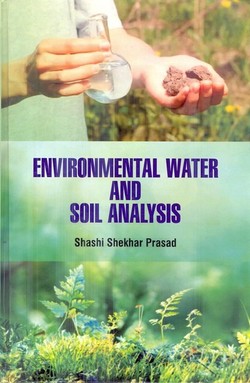
Environmental Water and Soil Analysis
By
Shashi Shekhar Prasad
Preface
Freshwater environmental quality parameters are the natural and man- made chemical, biological and microbiological characteristics of rivers, lakes and ground-waters, the ways they are measured and the ways that they change. The values or concentrations attributed to such parameters can be used to describe the pollution status of an environment, its biotic status or to predict the likelihood or otherwise of a particular organisms being present. Monitoring of environmental quality parameters is a key activity in managing the environment, restoring polluted environments and anticipating the effects of man-made changes on the environment. Water pollution is the contamination of water bodies (e.g. lakes, rivers, oceans and groundwater).
Water pollution occurs when pollutants are discharged directly or indirectly into water bodies without adequate treatment to remove harmful compounds. Water pollution affects plants and organisms living in these bodies of water. In almost all cases the effect is damaging not only to individual species and populations, but also to the natural biological communities. Water pollution is a major global problem which requires ongoing evaluation and revision of water resource policy at all levels (international down to individual aquifers and wells). It has been suggested that it is the leading worldwide cause of deaths and diseases, and that it accounts for the deaths of more than 14,000 people daily. An estimated 700 million Indians have no access to a proper toilet, and 1,000 Indian children die of diarrheal sickness every day.
Water pollutants may cause disease or act as poisons. Bacteria and parasites in poorly treated sewage may enter drinking water supplies and cause digestive problems such as cholera and diarrhea. Hazardous chemicals, pesticides, and herbicides from industries, farms, homes and golf courses can cause acute toxicity and immediate death, or chronic toxicity that can lead to neurological problems or cancers. Many water pollutants enter our bodies when we use water for drinking and food preparation. The pollutants enter the digestive tract. From there, they can reach other organs in the body and cause various illnesses. Chemicals come in contact with the skin from washing clothes, or from swimming in polluted water and may lead to skin irritations. Hazardous chemicals in water systems can also affect the animals and plants which live there. Sometimes these organisms will survive with the chemicals in their systems, only to be eaten by humans who may then become mildly ill or develop stronger toxic symptoms. The animals and plants themselves may die or not reproduce properly. Wastewater is water that has been used and must be treated before it is released into another body of water, so that it does not cause further pollution of water sources. Wastewater comes from a variety of sources. Everything that you flush down your toilet or rinse down the drain is wastewater. Rainwater and run-off, along with various pollutants, go down street gutters and eventually end up at a wastewater treatment facility. Wastewater can also come from agricultural and industrial sources. Some wastewaters are more difficult to treat than others; for example, industrial wastewater can be difficult to treat, whereas domestic wastewater is relatively easy to treat (though it is increasingly difficult to treat domestic waste, due to increased amounts of pharmaceuticals and personal care products that are found in domestic wastewater.
Soil formation, or pedogenesis, is the combined effect of physical, chemical, biological, and anthropogenic processes on soil parent material. Soil genesis involves processes that develop layers or horizons in the soil profile. These processes involve additions, losses, transformations and translocations of material that compose the soil. Minerals derived from weathered rocks undergo changes that cause the formation of secondary minerals and other compounds that are variably soluble in water, these constituents are moved (translocated) from one area of the soil to other areas by water and animal activity. The alteration and movement of materials within soil causes the formation of distinctive soil horizons. In addition, water alters the soil profile by dissolving and re-depositing minerals, often at lower levels, and possibly ieaving the soil sterile in the case of extreme rainfall and drainage. In a loam soil, solids constitute half the volume, gas one-quarter of the volume, and water one-quarter of the volume of which only half will be available to most plants.
The chemistry of soil determines the availability of nutrients, the health of microbial populations, and its physical properties. In addition, soil chemistry also determines its corrosivity, stability, and ability to absorb pollutants and to filter water. It is the surface chemistry of clay and humus colloids that determines soil's chemical properties. "A colloid is a small, insoluble, non- diffusible particle larger than a molecule but small enough to remain suspended in a fluid medium without settling. Most soils contain organic colloidal particles called humus as well as the inorganic colloidal particles of clays." The very high specific surface area of colloids and their net negative charges, gives soil its great ability to hold and release cations in what is referred to as cation exchange. Cation-exchange capacity (CEC) is the amount of exchangeable cations per unit weight of dry soil and is expressed in terms of milliequivalents of hydrogen ion per 100 grams of soil. This book provides deep insight to various dimensions of issues relating to the subject.
Contents
Chapter 1: Agricultural Water Pollution
Chapter 2: Environmental Pollution by Water Particles
Chapter 3: Water Pollution Water Quality
Chapter 4: Water Pollution Growth Environmental Quality
Chapter 5: Wastewater Treatment
Chapter 6: Soil Science
Chapter 7: Soil Farming Factors
Chapter 8: Soil Water
Chapter 9: Tillage Systems in Soil Conservation
Chapter 10: Soil Classification
***for more please visit the library***
Prep. / Ayman Ashry
Manage. / Mona Mahmoud


ساحة النقاش